12/17/2010

Festival of Chocolate Coming Soon to MOSI


Why Go "Bonkers" for Chocolate?

Did you know chocolate can actually be good for you? New studies show chocolate and its main ingredient, cocoa, help lower blood pressure, prevent cancer and help muscles recover from exercise and spruce up your skin. Surprisingly, chocolate also increases your brain activity and heart rate far more than a passionate-kiss. In short, you get a natural buzz from chocolate.

So, what in chocolate makes it so spectacular? The key is the increase of antioxidants caused by flavonoids. Scientists have identified two types of flavonoids that have powerful antioxidant effects: flavanols and procyanidins. Studies show flavanols and procyanidins are stable during gastric transit. After absorption, the flavanols are mainly methylated and glucuronidated or are bound to sulphate. Flavanols act as an antioxidant by donating hydrogen (from the hydroxyl group), thereby neutralizing free radicals and by chelating metal ions.

Although the level of flavonoids in cocoa is dependent on variety, time of harvest and climate, it’s still good for you. Turns out, cocoa may have stronger antioxidant properties than blueberries, garlic, tea or red wine.

So, if you feel the need to overindulge in chocolate, make sure to join MOSI this January for the Festival of Chocolate.


The Festival of Chocolate
Florida’s Largest All-Chocolate Shopping, Tasting, Educational and Interactive Event!
January 15-17, 2011

We will see you there!

10/05/2010

Jeanne Wood- Volunteer of the Month for October 2010

imageJeanne Wood has been volunteering at MOSI since 2009 and so far has incurred over 600 hours of volunteer service. Jeanne works in a variety of areas in the museum, docent, interactive exhibit facilitator, Vol. floor staff manager and most recently a member of the Volunteer Directorate Council (VDC).

As a member of the VDC Jeanne works with her team to identify ways to enhance the guest experience at MOSI. She is also responsible for the incredible recycling exhibition currently in the KIC building at the Science to Go store. Thanks Jeanne for your excellent support! Your impact is felt and seen all over the campus!

9/13/2010

International Observe the Moon Night

image On Saturday, September the 18th we invite you to join us at MOSI as we turn our eyes towards the heavens and a waxing gibbous moon on International Observe the Moon Night.

This is the second annual event of this name that celebrates exploration and observation of the moon. Started last year in celebration of the Lunar Reconnaissance Orbiter (LRO) and the Lunar Crater Observation and Sensing Satellite (LCROSS), International Observe the Moon Night brings an international community together for a single night of moon observation.

The Lunar Reconnaissance Orbiter (LRO) orbits just 50km above the surface of the moon. This robotic spacecraft is engaged in a 3D mapping mission that will help NASA identify potential moon landing sites for upcoming missions and locate formerly unknown resources on the lunar surface. The LRO has also brought us some of the first photographs of Apollo equipment that was left on the lunar surface.

Lunar Crater Observation and Sensing Satellite (LCROSS) was intentionally crashed into the Cabeus crater on the lunar surface near the moon’s south pole on October 9, 2009. The Centaur module of the LCROSS impacted the lunar surface and the Shepherding Spacecraft fallowed four minutes behind to analyze the plume of debris shot upward by the impact. LCROSS achieved its objective and discovered proof of water ice on the moon

This year MOSI is hosting an official International Observe the Moon Night event that will begin at 7:30pm on September the 18th. We will have binoculars and telescopes available for lunar observation, talks by lunar experts, activities and a show in the Saunder’s Planetarium.

Program fee: $12 per person
MOSI member: $9 per person
Call (813) 987-6000 to register; advance reservations are recommended. Limited seating is available for the lunar shows in The Saunder’s Planetarium.

9/01/2010

Volunteer of the Month: Jill Staake

Jill Jill Staake has been volunteering with MOSI Outside since August 2009 and has devoted 250 hours to the BioWorks Butterfly Garden and Richard T. Bowers Historic Tree Grove. A skilled gardener and budding butterfly expert, Jill is a fantastic volunteer who is always ready to answer guest questions about the gardens.

Jill is the author of a blog about gardening in Tampa Bay entitled My Florida Backyard and has worked hard to create her yard as a National Wildlife Federation Certified Wildlife Habitat. Jill is also a contributor to the BioWorks Butterfly Garden blog and recently created a post about a day in the life of a MOSI Outside volunteer entitled Perspiration and Inspiration. Look for Jill in the gardens on Tuesdays and Fridays.

8/16/2010

Volunteer of the Month: William White

William_White_August2010_WEB William White has volunteered at MOSI since May and thus far has incurred a total of approximately 213 hours of volunteer service. William quickly absorbed responsibilities above and beyond those of the floor InterActor and was promoted to Floor Manger.

William was named volunteer of the month for July and we greatly appreciate his incredible initiative, ambition and drive! William has set a new standard for MOSI volunteers and volunteers in general!

8/12/2010

Fractal Quilts by Rose Rushbrook

Currently on display in the Connecting Corridor Gallery are a selection of Fractal Art Quilts by Rose Rushbrook.

What is a fractal?: A fractal is "a rough or fragmented geometric shape that can be split into parts, each of which is (at least approximately) a reduced-size copy of the whole,".(1) image
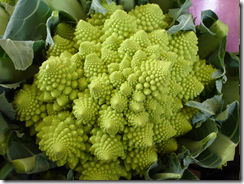
Let’s take an example from nature, Romanesco Broccoli (Brassica oleracea) which can be described as a naturally occurring fractal. The main branches of this cauliflower relative are arranged in an ever increasing spiral curve also known as a logarithmic spiral. Each bud is composed of smaller buds that are similarly arranged in a logarithmic spiral making each branch a seemingly tiny copy of the whole.

The term fractal derives from the Latin word fractus which means “broken” or “fractured” and was coined in 1975 by French/American mathematician Benoît Mandelbrot. Mandelbrot is known as the father of fractal geometry.

DSCN0846 Fractals in Quilts: Artist Rose Rushbrooke takes the self-similarity designs of fractals and uses them as the basis for her art quilts. The artist begins with an image designed using fractal and graphic software. This image is translated to a black and white line drawing which is used to transfer the pattern to fabric.

As her media, Rose uses hand-dyed fabrics, velvets, quilting cotton, yarn, thread and ribbon. Using piecing and appliqué, the artist constructs a fractal in fabric. This fractal is then embroidered, beaded, embellished and finally sandwiched, quilted and bound to create a unique piece of mathematical art. DSCN0847

The first quilt pictured is entitled “Upon Reaching Middle Age: Grease”. The pattern is extracted from the Julia Set fractal and is executed in hand dyed and printed cotton, silk and polyester fabrics. The quilt is machine stitched and quilted in long cursive lines of the word ‘grease’ repeated again and again. Created in 2004 this quilt measures 62” x 82”.

About this quilt the artist writes: “Where did all the fat come from, the cellulite, the double chin, the dangle under the arms, the dissappearing waist? Whatever happened to the lithe and slim young body? Middle age came and the grease set in.”

DSCN0848 This next quilt is entitled “Royal Crustacean”. The pattern is an original fractal design. Executed in printed silk charmeuse, silk ribbon and embroidery floss, this quilt is hand embroidered and quilted. The finished piece measures a diminutive 18” by 14” and is mounted on a canvas frame.

About the title of this quilt the artist writes “The repetitive fractal image resembles a lobster tail and purple is the colour of royalty”

You can read more about Rose Rushbrooke’s creation process for fractal quilts in this article.

About the Artist: Rose RushbrookeDSCN0850

Born in London, England. Lived abroad since 1986; moving to Antigua in the West Indies, then to Virginia and recently, Florida. Met her American husband in the Islands and relocated to the States in 1996.

Interest in modern fractal geometry led to using these fascinating images as a starting point for textile work. This artwork ranges from tiny pieces of embroidered silk; to large hand stitched fabric wallhangings.

Exhibits nationally and internationally. Five pieces were selected for 'The Marriage of Art, Science and Philosophy' exhibition at the American Visionary Art Museum in Baltimore, Maryland.

Recently spent two years earning an Advanced Diploma in Character Animation.

Filmed by HGTV for 'Simply Quilts', and by Adelphia for 'Artscape'; she is no longer owed her fifteen minutes of fame.

You can learn more about the artist, Rose Rushbrooke at her website Rushbrooke Strand. These fractal quilts will be on display at MOSI until September 6th, 2010.

(1)Mandelbrot, B.B. (1982). The Fractal Geometry of Nature. W.H. Freeman and Company.. ISBN 0-7167-1186-9.

8/09/2010

MOSI’s Scientist Breeding Program

MOSI’s latest genetics experiment is in full swing. Here at MOSI, we are breeding the scientists of tomorrow! By carefully selecting MOSI scientific education staff as parents, we can guarantee that the future crop of scientists are destined for greatness!

image Calliope Lynn McIlrath was born on April 6th, 2010. Her mommy, Vivian McIlrath is our Youth Programs Coordinator. Vivian started at MOSI as a teenager in our YES! Team Program, attended USF, and continued teaching science and dissecting sharks all the while.

Calliope’s future goals will be to matriculate at a cool nursing school, begin eating solid foods, and to become potty trained. Her career goal is to become a marine biologist.

image

Rosabelle Marie Easterling was born on July 19th, 2010 to proud parents Luke and Lakin. Luke started in MOSI’s Education department in his young teenage years, left us to attend college and then was magnetically drawn back to MOSI.

We expect that Rosabelle will be working soon enough at MOSI with her dad, Uncle Jeff and Uncle Trevor. Clearly, MOSI just can’t get enough of this Easterling family. Future plans for Rosabelle include her development of new science shows for the museum, breakthrough work in string theory and the ability to crawl.

imageJocelyn Freya Hill, born May 8th 2010, is the newest of three itty bitty scientists produced by Tim Hill and his lovely wife Cara. No one really remembers how long Tim has been in the MOSI education department… he may have budded from the building itself.

As you can see by her attire, Jocelyn may well be headed into the time honored field of entomology. In the mean time she will work on bright smiles, ambulatory skills and safe handling of liquid nitrogen. Jocelyn will be helped along in her scientific endeavors by her two older siblings.pic

Alina Ponds was born August 8, 2009. Alina’s proud daddy AJ works in reservations and is one of the people you are most likely to have help you when you call the museum.

Alina’s future goals are to tackle sprinting, climbing, and using utensils. Her future career goal is to become a Marine Biologist.