Showing posts with label science. Show all posts

9/08/2011

Sky Trail Ropes Course Now Open

MOSI’s new Sky Trail® Ropes Course is now open! The course opened on July 18th and since then over 10,000 people have conquered their fears and challenged the course.


The course features several types of obstacles in varying difficulties. These obstacles include rope bridges, balance beams and rope swings. The course is divided into three levels and ranges from 12 to 36 feet in the air.


The easiest obstacles are on the lowest level and feature more handles to grab on to while you are crossing. They also tend to be more stable and easier to cross.


The middle level contains slightly more challenging obstacles. While it may feature many of the same types of crossings, these crossings tend to sway the challenger slightly more.


The upper level is slightly smaller than the lower two but features the best views and most rewarding obstacles of the course. At 36 feet in the air feel free to gaze across parts of USF’s campus or simply check out the traffic on Fowler Avenue for your drive home.


Afraid of falling? Don’t be! Before beginning the course each person is strapped in to a safety harness making slips only a delay. MOSI employees are specially trained for the course and are also stationed to help you make it to the end. If you’re still afraid of challenging the next element of the course feel free to hold on to your anchor as you cross to the next island.


The course takes around 30 to 45 minutes to complete on average if you choose to complete every challenge on the course. However you are free to skip any bridges, and you can even climb straight to the top if you’re confident enough to take on the most difficult portions of the course.

The course will be open everyday. Weekday hours will be noon – 5 p.m. Saturday the course will open at 10 a.m. and close at 8 p.m. On Sunday it opens at 10 a.m. and closes at 6 p.m.

Although you are able to tackle the new course solo, group rates are available. Please visit our website at www.mosi.org or call (813) 987-6000 for more information.

The only requirements are closed toe shoes, a height of at least 48 inches (or 42 if accompanied by an adult) and a sense of adventure.
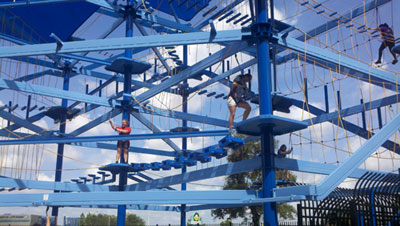


MOSI would also like to thank the Boys & Girls Club of Tampa for letting MOSI host their team-building exercise and for challenging the ropes course together.

3/07/2011

Science Right Now: Good morning astronauts!

Morning wake up calls have been a NASA tradition since the days of the Apollo missions when mission control staff would serenade astronauts with lines from popular songs. Since then, morning wake up calls are more often recordings of songs played to begin the day’s activities and are followed by a message from the CAPCOM in mission control. These recordings have included “Rocket Man” by Elton John, “I Feel the Earth Move” by Carole King, the Marine Corps Hymn, “Over the Rainbow” by Judy Garland and hundreds of other songs.

This morning’s wake up call to the space shuttle Discovery was not a favorite song of an astronaut, instead it was an iconic voice speaking over a piece of iconic science fiction music. At 3.23 EST this morning, William Shatner reprised the role of the Enterprise’s Captain Kirk and addressed the crew of Discovery with the following message spoken over the theme music from the original series of Star Trek:

"Space, the final frontier. These have been the voyages of the space shuttle Discovery. Her 30 year mission: To seek out new science. To build new outposts. To bring nations together on the final frontier. To boldly go, and do, what no spacecraft has done before,"

Good morning astronauts!

After 30 years of service, 39 flights and 13 trips to the International Space Station, Discovery will return just before noon on Wednesday to Kennedy Space Center in Florida for the last time.

For a full listing of morning wake up calls that have greeted astronauts, check out this list created by NASA historian, Colin Fries.

7/22/2010

Fingerprint Fun

A fingerprint is an impression of the pattern of ridges of a finger.DSCN0828 Because no two people have the exact same patterns of finger ridges, that unique pattern can be linked to a fingerprint left on an object. Fingerprints collected at a crime scene can be used in forensic science to identify a suspect, victim or any other person that may have touched a surface.

The science of fingerprint identification is also known as dactyloscopy. This term derives from the ancient Greek words daktylos which means “finger” and skopeĊ “I look at”. Fingerprints have been recorded as used since Ancient Babylon where business people would press their fingerprints into clay tablets to record business transactions.

The classification system used through most of the 20th century in the United States was developed in India in the late 1800’s by Sir Edward Henry. This is known as the Henry Classification System. This system breaks fingerprints down into three main categories: Loop, Whorl and Arch. The Loop, Whorl and Arch types of fingerprints represent 60-65, 30-35 and 5 percent of all fingerprints, respectively. This system is used more to exclude fingerprints based on their designs rather than to identify a single fingerprint.

Fingerprints at a Crime Scene: Fingerprints can be plastic, patent or latent. Plastic prints are left in a soft surface like wax or putty. Patent prints are visible to the eye and occur when your finger first touches a colored substance like ink and then presses against a surface and leaves a mark. Latent prints are invisible to the eye and are made up mostly of oils and sweat on your skin.

DSCN0822 Forensic scientists use many methods to make latent prints visible. On a solid surface like a mirror or countertop a fine dust can be applied that will stick to the oils left behind in a fingerprint. On a bumpy or uneven surface a fingerprint can be revealed by using heated superglue! On a surface like paper, specific chemicals can be used to develop the fingerprint so that it becomes visible.

The FBI maintains a fingerprint and criminal history database called the Integrated Automated Fingerprint Identification System or IAFIS. Fingerprints are voluntarily submitted to IAFIS from local, state and federal agencies and come from criminal and non-criminal sources.

Put your investigative skills to the test in the exhibit CSI: The Experience, created in cooperation with the hit CBS franchise. You’ll use cutting edge forensic science and technology to investigate a crime scene, analyze evidence and build a case. Discover if your skills solve the crime … or leave the case cold!

CSI: The Experience was developed by the Fort Worth Museum of Science and History with support from CBS Consumer Products, the cast and crew of the television show, the American Academy of Forensic Sciences, and the National Science Foundation. ® CBS © 2000-2010 CBS Broadcasting, Inc. and Entertainment AB Funding LLC. All Rights Reserved.

9/29/2009

Bernoulli Breezeball

As you can see in the video, the orange balls are being held up only by air blown out of the tubes on the Bernoulli Breezeball exhibit. By adjusting the direction of the tubes you can pass the balls from one airstream to another and eventually into the hoops at the ends of the table.

How does it work:
Moving air has less pressure (pushing power) than still air. Objects may look as if they are sucked into a stream of moving air but are actually being pushed into the stream by the stronger pressure of the air around the stream. When a ball is placed into an airstream, the air flowing upward hits the bottom of the ball and slows down, generating a region of higher pressure. This high-pressure region of air under the ball holds it up. If you try to pull the ball slowly out of the airstream, the air arcs around the ball and its pressure is decreased. The normal pressure on the other side of the ball pushes it back into the airstream.

Daniel Bernoulli:
The Bernoulli Breezeball exhibit is named for Daniel Bernoulli (1700-1782) who was a member of a Swiss family that boasted several famous mathematicians. Bernoulli applied mathematics to the fields of fluid mechanics and also pioneered mathematics work in probability and statistics. He taught at the University of St. Petersburg and later at the University of Basel where he successively chaired the departments of medicine, metaphysics and natural philosophy. Daniel Bernoulli is best known for 1738 publication Hydrodynamica and for Bernoulli's principle which describes the relationship of the speed of a fluid and its pressure.

Bernoulli's principle and aerodynamics:
Bernoulli's principle can be applied to aerodynamics. Using Bernoulli's principle you can calculate the lift force on an airfoil. Airplane wings utilize an airfoil shape that is curved on the top and flat on the bottom. In motion, air flows faster over the curved surface on the top of an airfoil than under the flat bottom. The faster moving air decreases in pressure so less pressure is being applied to the top of an airplane wing than to the bottom. This difference in pressure creates an upwards lift force. If the speed of the air over and under the wing is known, Bernoulli's equations can be used to calculate the lift force upon the airfoil.

Read more about Bernoulli's Principle applied to aerodynamics at the US Centennial of Flight Commission website.

9/14/2009

That Rocks: Muscovite

Known also as Common Mica or Isinglass is a common mineral found in igneous, metamorphic and sedimentary rocks. Muscovite occurs in a variety of brown, gray, yellow and smoky green colors but can also be found in transparent and translucent forms.

Muscovite is used for a range of commercial applications as the mineral forms in natural sheets and is an excellent insulator of electricity and heat. Cleaved into super thin sheets, muscovite has been used for lining the viewing windows of industrial furnaces and also for lining the viewing doors of old microwave ovens.

The name muscovite derives from the term Muscovy-glass as sheets of this minerals have been used as windows in Russia. The base of this names come from the Latin word "micare" which means "to shine".

Muscovite has a Mohs hardness of 2-2.25.

A sheet of muscovite is on display in the Science Alcove in the Science Library at MOSI.

8/19/2009

Tensile Intergrity Sphere

Hanging high above the center of the MOSI Grand Lobby is a very large and odd-looking sphere composed of yellow rods and wire. If you spend a few moments and really look at the sphere you will see that none of the yellow rods that compose the sphere are touching each other. This neat bit of science is known as a Tensile Integrity Sphere.

How does it work?:
A tensile integrity sphere or tensegrity sphere is a structure that utilizes synergy of components in balanced compression and tension for structural support.

Compression is stress or force applied to materials resulting in their compaction. In the case of this sphere the yellow rods are under compression. Tension is a force that pulls upon an object using strings or wires and is the opposite of compression. The wires in the tensegrity sphere are in tension. Synergy is a situation where different entities or forces cooperate advantageously for a final outcome, in our case keeping the sphere round without external supports. Utilizing the forces of compression and tension in synergy this 130 pound sphere is entirely self-supporting and hangs from the ceiling with just a few strong cables that support the weight of the entire sphere.

Tensegrity:
The concept of tensegrity was popularized by R. Buckminster Fuller and Kenneth Snelson at Black Mountain College in the 1940's. Building upon an early design of a self supporting sphere structure used as a planetarium in Germany, Fuller and Snelson explored concepts of tensegrity.
The term 'geodesic' was coined by Fuller and applied to structures that could be incredibly light for their size when compression and tension were used in balance to create structures that were self supporting. Within a geodesic dome, no internal supports are required. Just imagine your house without any need for walls! Geodesic structures had potential to be spacious, light weight, strong and inexpensive to produce.
"Ability to respond as a system means that local stresses are being uniformly transmitted throughout the structure, and uniformly absorbed by every part of it. The system's symmetry is not deformed: the system expands as a whole or contracts as a whole. This is not the behavior we are used to in any structures of our previous experiences. The compression members do not behave like conventional engineering beams... Ordinary beams deflect locally. The tensegrity "beam" does not act independently of "the whole building" which contracts only symmetrically when the beam is loaded. The tensegrity system is synergetic - a behavior of the whole unpredicted by the behavior of the parts" -R. Buckminster Fuller. Synergetics: explorations in the geometry of thinking. New York, Macmillan, 1975
The story of our sphere:
In November of 2000 the museum was approached by Richard 'Dick' Avery who had an interesting proposal. He wanted to build an enormous tensegrity sphere for the museum to display. Dick had found a book on R. Buckminster Fuller in the Science Store at MOSI some time before and had become enamored of the concepts of tenesgrity. At home in Sun City Center, Dick had already built a few tenesgrity spheres and offered to build one for MOSI.

Dick spent 107 hours constructing the sphere in January and February of 2001 and shortly after it was hung in our grand lobby. It was quite a sight to see a gigantic yellow sphere sitting on the floor of the lobby and several exhibit technicians carefully considering how they were going to hoist the monster shape into place. After a few hours, the great tensegrity sphere hung above our lobby and hangs there to this day. Mr. Avery passed away several years ago, but his creation still looms larger than life over hundreds of thousands of people each year.

8/17/2009

Diplodocus in the Grand Lobby

Around 150 to 147 million years ago, at the end of the Jurassic Period, enormous sauropod dinosaurs roamed wide portions of the planet.

Around 90 feet in length from head to tip of the tail, the Diplodocus would have needed massive amounts of food to sustain its huge size. Diplodocus likely grazed its way through the western North American conifer forests using its peg like teeth to strip foliage from trees and low growing cycads and club mosses. Their long necks may have allowed them to reach into thick-treed forests where their bodies were too big to enter, reach foliage higher up in trees or even be able to graze on soft water plants while still standing on dry land that would support their 10-16 tons of weight. The heads of these massive dinosaurs measure less than two feet in length, leaving only a tiny amount of space for a brain.

First discovered in 1877 by Earl Douglass and Samuel W. Williston, diplodocus fossils have been found throughout Colorado, Wyoming, Utah and Montana. Diplodocus, meaning "Double-beamed", was named by paleontologist Othniel C. Marsh in 1878 for the chevron shaped bones on the underside of its tail.

The MOSI Grand Lobby houses two full sized Diplodocus skeletons which are actually casts of the same fossilized Diplodocus. One is shown in a standing position and the other placed in a rearing position with its head reaching high up toward the ceiling. During the Assemble a Sauropod project over 500 donors came together and along with two grants MOSI was able to purchase two Diplodocus casts!
Because the are so fantastically large, there are literally dozens of angles from which to view the Diplodocus. Great spots to see these skeletons are the Grand Lobby, 2nd floor balcony near Weather Quest, Grand Staircase, 2nd floor Lobby overlook and the 3rd floor balcony by Science Works Theater.

The Diplodocus have been known to wear the occasional Santa hat around the winter holidays. On their tiny heads an average person-sized Santa hat works quite nicely!

8/12/2009

Funky Science: Lava lamps

The Science Store at MOSI has a really huge lava lamp on display and lots of smaller lava lamps for sale right now. The large lava lamp is really awesome to watch so I thought perhaps we should talk about the science of lava lamps!

Lava Lamps: Lava lamps, also known as liquid motion lamps, have been around since the 60's. They are very cool to watch but there are some neat principles of science in action.

So how does a liquid motion lamp work? Liquid motion lamps require the use of two insoluble, near equal density liquids and a heat source used for adjusting the density of the liquids. Now lets break that down into bite sized pieces.

Liquids: One liquid forms the slow moving blobs, like in the picture, we will call this Red. The other liquid allows the blobs to float about, we'll call this liquid Purple.
  • These liquids must be immiscible, or mutually insoluble. This means that neither liquid will dissolve the other like oil and water and that Red and Purple will remain separate.

  • These liquids must be of a nearly equal density.

When turned off, liquid motion lamps appear to have two distinct layers of liquids . One is just slightly more dense than the other and lays on the bottom of the lamp. In our case the Red liquid is slightly more dense than the Purple liquid. Being more dense causes the Red liquid to sink to the bottom.

Heat: The heat source in a liquid motion lamp is generally a light bulb or lamp. As you likely know, light bulbs can get pretty hot when they have been turned on. When the lamp is turned on it heats up the slightly more dense Red liquid at the bottom of the lamp.

Changing the temperature of a compound is an easy way to change density. When a compound is heated the molocules in the compound spread apart making it less dense. As the density decreases, the compond become lighter and will rise above heavier, more dense compounds. For example, think of air: hot air rises and cold air sinks. Heated air becomes less dense and becomes "lighter" which causes it to rise above the more dense, "heavier" cool air.

Much like hot air, the Red liquid at the bottom of the lamp will become less dense as it is heated. This makes the Red liquid "lighter" and it begins to rise in blobs through the Purple liquid.

As they rise through the Purple liquid and away from the heat source, the Red blobs lose heat. This causes the molecules in the Red liquid to move closer together and this increases the density of the Red liquid. The Red blobs are become more dense than the Purple liquid and sink back to the bottom. At the bottom the Red liquid is warmed up again and the process repeats until you turn off the lamp and all the Red liquid cools down.

This really neat Wiki How article shows you how to make a liquid motion lamp with household items and no heat! Be a scientist at home!