9/16/2009

Touch a tornado

What does a tornado look like up close and personal? Well, most of us really don't want to have a personal experience with such a force of nature just to satisfy our curiosity. A mist vortex is a safe way to get up close to and even touch a vortex. In this exhibit water vapor is released from a tank at the bottom and a fan at the top of the exhibit swirls the air and vapor into a vortex. The six posts on the exhibit all have tiny air vents that blow air in a single direction that helps to corral the water vapor and keep it turning in a tornado-like vortex.

Originally designed at the Exploratorium during an artist in residence program, mist vortexes have become a great way to show science center guests how a tornado looks up close. Our mist vortex is located on the second floor of MOSI's main building in the Disasterville exhibit Tornado section. MOSI's Disasterville exhibit also educates guests about floor, hurricanes, tsunami, wildfire, earthquake, lighting, volcano, hail and other forces of nature with awesome destructive power. To know how these disasters work helps people to prepare plans for what do do if a natural disaster ever touches their lives.

9/14/2009

That Rocks: Muscovite

Known also as Common Mica or Isinglass is a common mineral found in igneous, metamorphic and sedimentary rocks. Muscovite occurs in a variety of brown, gray, yellow and smoky green colors but can also be found in transparent and translucent forms.

Muscovite is used for a range of commercial applications as the mineral forms in natural sheets and is an excellent insulator of electricity and heat. Cleaved into super thin sheets, muscovite has been used for lining the viewing windows of industrial furnaces and also for lining the viewing doors of old microwave ovens.

The name muscovite derives from the term Muscovy-glass as sheets of this minerals have been used as windows in Russia. The base of this names come from the Latin word "micare" which means "to shine".

Muscovite has a Mohs hardness of 2-2.25.

A sheet of muscovite is on display in the Science Alcove in the Science Library at MOSI.

9/01/2009

September Volunteer of the Month: Deamyon “Dae” Myles

Deamyon “Dae” Myles is the volunteer of the month for September 2009.

Deamyon is a ‘high impact’ volunteer who since June has incurred 198.75 hours of volunteer service. Deamyon was the first summer volunteer to receive a volunteer flower award for excellent guest service. The volunteer flower awards are the first level of our rewards program. Upon receiving 3 flowers the volunteer is awarded a sticker for the front of their name tag and a prize pack with Pizza and movie passes or Bowling/laser tag vouchers. Deamyon was the first summer volunteer to receive the Silver Sticker!

He is an excellent example of brilliant guest service and is consistently looking, seeking and finding ways to enhance a guest’s experience at MOSI. Deamyon is always ready with a smile and helpful attitude. In addition to working as a Greeter and Volunteer InterActor, “Dae” also comes in for 3 hours on Saturday to dress as Scooby Doo and/or Dexter to entertain our guests. Congratulations Deamyon, your hours of tireless service are much appreciated and your support makes MOSI a better place staff and guests alike!

8/31/2009

From the special collections: The MOSI Topaz

Ever wonder what 1,379 carats worth of cut and polished blue topaz would look like in your hand? Well, a lot like this. That's my hand to the left pictured with a very remarkable stone, a gigantic blue topaz.

This remarkable stone is a gorgeous clear blue color. Pure topaz is clear but most topaz stones form with some impurities that cause the stones to be colored blue, red, brown, yellow, gray, green and even pink. Pale and sky blue topaz are prized for jewelry pieces.

Although this stones seems enormous, it is certainly nowhere near the size of the largest known cut topaz stones. In Brazil, colorless pure topaz have been found in sizes as large as boulders. The largest cut topaz, also from Brazil, is the El-Dorado Topaz that is 31,000 carats. Another well known cut topaz, the American Golden Topaz at the Smithsonian is 22,892.5 carats.


Topaz is an 8 on the hardness scale of gemstones which puts it near the hardest and toughest stones known to man. Diamonds used for jewelry and even on saw blades are a 10 on the hardness scale. If you have topaz or diamond jewelry it should be stored away from other stones because it may scratch the surfaces of softer gems.

This stone was donated to MOSI by a gentleman in the late years of his life who wished to leave a legacy piece to a local museum. The stone is not currently on display in the museum so these pictures give you a special backstage peek at a truly beautiful gemstone.

8/19/2009

Tensile Intergrity Sphere

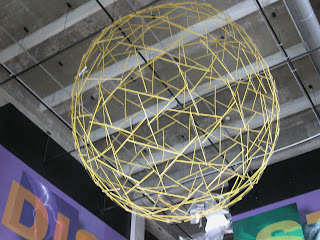
Hanging high above the center of the MOSI Grand Lobby is a very large and odd-looking sphere composed of yellow rods and wire. If you spend a few moments and really look at the sphere you will see that none of the yellow rods that compose the sphere are touching each other. This neat bit of science is known as a Tensile Integrity Sphere.

How does it work?:
A tensile integrity sphere or tensegrity sphere is a structure that utilizes synergy of components in balanced compression and tension for structural support.

Compression is stress or force applied to materials resulting in their compaction. In the case of this sphere the yellow rods are under compression. Tension is a force that pulls upon an object using strings or wires and is the opposite of compression. The wires in the tensegrity sphere are in tension. Synergy is a situation where different entities or forces cooperate advantageously for a final outcome, in our case keeping the sphere round without external supports. Utilizing the forces of compression and tension in synergy this 130 pound sphere is entirely self-supporting and hangs from the ceiling with just a few strong cables that support the weight of the entire sphere.

Tensegrity:
The concept of tensegrity was popularized by R. Buckminster Fuller and Kenneth Snelson at Black Mountain College in the 1940's. Building upon an early design of a self supporting sphere structure used as a planetarium in Germany, Fuller and Snelson explored concepts of tensegrity.
The term 'geodesic' was coined by Fuller and applied to structures that could be incredibly light for their size when compression and tension were used in balance to create structures that were self supporting. Within a geodesic dome, no internal supports are required. Just imagine your house without any need for walls! Geodesic structures had potential to be spacious, light weight, strong and inexpensive to produce.
"Ability to respond as a system means that local stresses are being uniformly transmitted throughout the structure, and uniformly absorbed by every part of it. The system's symmetry is not deformed: the system expands as a whole or contracts as a whole. This is not the behavior we are used to in any structures of our previous experiences. The compression members do not behave like conventional engineering beams... Ordinary beams deflect locally. The tensegrity "beam" does not act independently of "the whole building" which contracts only symmetrically when the beam is loaded. The tensegrity system is synergetic - a behavior of the whole unpredicted by the behavior of the parts" -R. Buckminster Fuller. Synergetics: explorations in the geometry of thinking. New York, Macmillan, 1975
The story of our sphere:
In November of 2000 the museum was approached by Richard 'Dick' Avery who had an interesting proposal. He wanted to build an enormous tensegrity sphere for the museum to display. Dick had found a book on R. Buckminster Fuller in the Science Store at MOSI some time before and had become enamored of the concepts of tenesgrity. At home in Sun City Center, Dick had already built a few tenesgrity spheres and offered to build one for MOSI.

Dick spent 107 hours constructing the sphere in January and February of 2001 and shortly after it was hung in our grand lobby. It was quite a sight to see a gigantic yellow sphere sitting on the floor of the lobby and several exhibit technicians carefully considering how they were going to hoist the monster shape into place. After a few hours, the great tensegrity sphere hung above our lobby and hangs there to this day. Mr. Avery passed away several years ago, but his creation still looms larger than life over hundreds of thousands of people each year.

8/17/2009

Diplodocus in the Grand Lobby

Around 150 to 147 million years ago, at the end of the Jurassic Period, enormous sauropod dinosaurs roamed wide portions of the planet.

Around 90 feet in length from head to tip of the tail, the Diplodocus would have needed massive amounts of food to sustain its huge size. Diplodocus likely grazed its way through the western North American conifer forests using its peg like teeth to strip foliage from trees and low growing cycads and club mosses. Their long necks may have allowed them to reach into thick-treed forests where their bodies were too big to enter, reach foliage higher up in trees or even be able to graze on soft water plants while still standing on dry land that would support their 10-16 tons of weight. The heads of these massive dinosaurs measure less than two feet in length, leaving only a tiny amount of space for a brain.

First discovered in 1877 by Earl Douglass and Samuel W. Williston, diplodocus fossils have been found throughout Colorado, Wyoming, Utah and Montana. Diplodocus, meaning "Double-beamed", was named by paleontologist Othniel C. Marsh in 1878 for the chevron shaped bones on the underside of its tail.

The MOSI Grand Lobby houses two full sized Diplodocus skeletons which are actually casts of the same fossilized Diplodocus. One is shown in a standing position and the other placed in a rearing position with its head reaching high up toward the ceiling. During the Assemble a Sauropod project over 500 donors came together and along with two grants MOSI was able to purchase two Diplodocus casts!
Because the are so fantastically large, there are literally dozens of angles from which to view the Diplodocus. Great spots to see these skeletons are the Grand Lobby, 2nd floor balcony near Weather Quest, Grand Staircase, 2nd floor Lobby overlook and the 3rd floor balcony by Science Works Theater.

The Diplodocus have been known to wear the occasional Santa hat around the winter holidays. On their tiny heads an average person-sized Santa hat works quite nicely!

8/13/2009

Getting Ready to go Back to School can be a whole bunch of fun!

Ready for School? Come to the Back to School Expo at MOSI and have the chance to win tickets to see the Jonas Brothers Concert

The Back to School Fair at MOSI on August 15th will have everything you need to prepare, protect and inspire your child before they go back to school. Health & Wellness, Safety, Private Schools, Childcare and Learning Centers, Local Resources, Afterschool Programs, Tutors, Children Retailers and more!!

Bring the whole family and for $10 per person they will enjoy all of MOSI’s exhibits including the new ANIMATION featuring Cartoon Network along with enjoying free activities, arts & crafts, games, workshops, live entertainment and informative speaker sessions- all day. Thousands of dollars worth of prizes given away every hour including tickets to the Jonas Brothers Concert. Come meet Scooby Doo, Dexter and Toots live in person. (MOSI members are free to the back to school event . ANIMATION featuring Cartoon Network exhbit fees apply )

The first 100 kids at the event will get a free back to school goodie bag filled with supplies and goodies from Tootsville.com and MEAD