9/13/2010

International Observe the Moon Night

image On Saturday, September the 18th we invite you to join us at MOSI as we turn our eyes towards the heavens and a waxing gibbous moon on International Observe the Moon Night.

This is the second annual event of this name that celebrates exploration and observation of the moon. Started last year in celebration of the Lunar Reconnaissance Orbiter (LRO) and the Lunar Crater Observation and Sensing Satellite (LCROSS), International Observe the Moon Night brings an international community together for a single night of moon observation.

The Lunar Reconnaissance Orbiter (LRO) orbits just 50km above the surface of the moon. This robotic spacecraft is engaged in a 3D mapping mission that will help NASA identify potential moon landing sites for upcoming missions and locate formerly unknown resources on the lunar surface. The LRO has also brought us some of the first photographs of Apollo equipment that was left on the lunar surface.

Lunar Crater Observation and Sensing Satellite (LCROSS) was intentionally crashed into the Cabeus crater on the lunar surface near the moon’s south pole on October 9, 2009. The Centaur module of the LCROSS impacted the lunar surface and the Shepherding Spacecraft fallowed four minutes behind to analyze the plume of debris shot upward by the impact. LCROSS achieved its objective and discovered proof of water ice on the moon

This year MOSI is hosting an official International Observe the Moon Night event that will begin at 7:30pm on September the 18th. We will have binoculars and telescopes available for lunar observation, talks by lunar experts, activities and a show in the Saunder’s Planetarium.

Program fee: $12 per person
MOSI member: $9 per person
Call (813) 987-6000 to register; advance reservations are recommended. Limited seating is available for the lunar shows in The Saunder’s Planetarium.

9/01/2010

Volunteer of the Month: Jill Staake

Jill Jill Staake has been volunteering with MOSI Outside since August 2009 and has devoted 250 hours to the BioWorks Butterfly Garden and Richard T. Bowers Historic Tree Grove. A skilled gardener and budding butterfly expert, Jill is a fantastic volunteer who is always ready to answer guest questions about the gardens.

Jill is the author of a blog about gardening in Tampa Bay entitled My Florida Backyard and has worked hard to create her yard as a National Wildlife Federation Certified Wildlife Habitat. Jill is also a contributor to the BioWorks Butterfly Garden blog and recently created a post about a day in the life of a MOSI Outside volunteer entitled Perspiration and Inspiration. Look for Jill in the gardens on Tuesdays and Fridays.

8/16/2010

Volunteer of the Month: William White

William_White_August2010_WEB William White has volunteered at MOSI since May and thus far has incurred a total of approximately 213 hours of volunteer service. William quickly absorbed responsibilities above and beyond those of the floor InterActor and was promoted to Floor Manger.

William was named volunteer of the month for July and we greatly appreciate his incredible initiative, ambition and drive! William has set a new standard for MOSI volunteers and volunteers in general!

8/12/2010

Fractal Quilts by Rose Rushbrook

Currently on display in the Connecting Corridor Gallery are a selection of Fractal Art Quilts by Rose Rushbrook.

What is a fractal?: A fractal is "a rough or fragmented geometric shape that can be split into parts, each of which is (at least approximately) a reduced-size copy of the whole,".(1) image
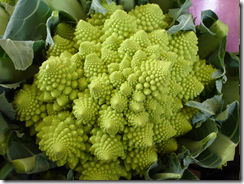
Let’s take an example from nature, Romanesco Broccoli (Brassica oleracea) which can be described as a naturally occurring fractal. The main branches of this cauliflower relative are arranged in an ever increasing spiral curve also known as a logarithmic spiral. Each bud is composed of smaller buds that are similarly arranged in a logarithmic spiral making each branch a seemingly tiny copy of the whole.

The term fractal derives from the Latin word fractus which means “broken” or “fractured” and was coined in 1975 by French/American mathematician Benoît Mandelbrot. Mandelbrot is known as the father of fractal geometry.

DSCN0846 Fractals in Quilts: Artist Rose Rushbrooke takes the self-similarity designs of fractals and uses them as the basis for her art quilts. The artist begins with an image designed using fractal and graphic software. This image is translated to a black and white line drawing which is used to transfer the pattern to fabric.

As her media, Rose uses hand-dyed fabrics, velvets, quilting cotton, yarn, thread and ribbon. Using piecing and appliqué, the artist constructs a fractal in fabric. This fractal is then embroidered, beaded, embellished and finally sandwiched, quilted and bound to create a unique piece of mathematical art. DSCN0847

The first quilt pictured is entitled “Upon Reaching Middle Age: Grease”. The pattern is extracted from the Julia Set fractal and is executed in hand dyed and printed cotton, silk and polyester fabrics. The quilt is machine stitched and quilted in long cursive lines of the word ‘grease’ repeated again and again. Created in 2004 this quilt measures 62” x 82”.

About this quilt the artist writes: “Where did all the fat come from, the cellulite, the double chin, the dangle under the arms, the dissappearing waist? Whatever happened to the lithe and slim young body? Middle age came and the grease set in.”

DSCN0848 This next quilt is entitled “Royal Crustacean”. The pattern is an original fractal design. Executed in printed silk charmeuse, silk ribbon and embroidery floss, this quilt is hand embroidered and quilted. The finished piece measures a diminutive 18” by 14” and is mounted on a canvas frame.

About the title of this quilt the artist writes “The repetitive fractal image resembles a lobster tail and purple is the colour of royalty

You can read more about Rose Rushbrooke’s creation process for fractal quilts in this article.

About the Artist: Rose RushbrookeDSCN0850

Born in London, England. Lived abroad since 1986; moving to Antigua in the West Indies, then to Virginia and recently, Florida. Met her American husband in the Islands and relocated to the States in 1996.

Interest in modern fractal geometry led to using these fascinating images as a starting point for textile work. This artwork ranges from tiny pieces of embroidered silk; to large hand stitched fabric wallhangings.

Exhibits nationally and internationally. Five pieces were selected for 'The Marriage of Art, Science and Philosophy' exhibition at the American Visionary Art Museum in Baltimore, Maryland.

Recently spent two years earning an Advanced Diploma in Character Animation.

Filmed by HGTV for 'Simply Quilts', and by Adelphia for 'Artscape'; she is no longer owed her fifteen minutes of fame.

You can learn more about the artist, Rose Rushbrooke at her website Rushbrooke Strand. These fractal quilts will be on display at MOSI until September 6th, 2010.

(1)Mandelbrot, B.B. (1982). The Fractal Geometry of Nature. W.H. Freeman and Company.. ISBN 0-7167-1186-9.

8/09/2010

MOSI’s Scientist Breeding Program

MOSI’s latest genetics experiment is in full swing. Here at MOSI, we are breeding the scientists of tomorrow! By carefully selecting MOSI scientific education staff as parents, we can guarantee that the future crop of scientists are destined for greatness!

image Calliope Lynn McIlrath was born on April 6th, 2010. Her mommy, Vivian McIlrath is our Youth Programs Coordinator. Vivian started at MOSI as a teenager in our YES! Team Program, attended USF, and continued teaching science and dissecting sharks all the while.

Calliope’s future goals will be to matriculate at a cool nursing school, begin eating solid foods, and to become potty trained. Her career goal is to become a marine biologist.

image

Rosabelle Marie Easterling was born on July 19th, 2010 to proud parents Luke and Lakin. Luke started in MOSI’s Education department in his young teenage years, left us to attend college and then was magnetically drawn back to MOSI.

We expect that Rosabelle will be working soon enough at MOSI with her dad, Uncle Jeff and Uncle Trevor. Clearly, MOSI just can’t get enough of this Easterling family. Future plans for Rosabelle include her development of new science shows for the museum, breakthrough work in string theory and the ability to crawl.

imageJocelyn Freya Hill, born May 8th 2010, is the newest of three itty bitty scientists produced by Tim Hill and his lovely wife Cara. No one really remembers how long Tim has been in the MOSI education department… he may have budded from the building itself.

As you can see by her attire, Jocelyn may well be headed into the time honored field of entomology. In the mean time she will work on bright smiles, ambulatory skills and safe handling of liquid nitrogen. Jocelyn will be helped along in her scientific endeavors by her two older siblings.pic

Alina Ponds was born August 8, 2009. Alina’s proud daddy AJ works in reservations and is one of the people you are most likely to have help you when you call the museum.

Alina’s future goals are to tackle sprinting, climbing, and using utensils. Her future career goal is to become a Marine Biologist.

8/06/2010

Analyzing Dental Impressions at Home

By: Samantha Ribble

Now through September 6, the Museum of Science and Industry (MOSI) is hosting to the traveling exhibit CSI: The Experience. This interactive exhibit turns guests into crime solvers as they investigate the scene, collect and analyze evidence, and bring the criminal to justice. With three different crime scenes to choose from and a high-tech laboratory, visitors are sure to walk away with a greater knowledge of what it takes to be a CSI.

Kids can be investigators in their own homes by analyzing evidence of the mouth – dental impressions.

Eighty percent of the time, teeth impressions are used to identify unknown victims. When fingerprints cannot be recovered and DNA testing is not possible, the teeth can give investigators a place to start. Since the enamel on your teeth is one of the hardest substances in your body, teeth are often well preserved.

Humans get two sets of teeth in their lifetime. By age three, children have a complete set of 20 baby teeth. Permanent teeth begin developing around the age of six and, over a span of 15 years, continue to cultivate until all 32 adult teeth are in place.

Teeth can reveal age by looking closely at level of development and wear. Dental records help investigators match a person’s mouth to a name.

All you need to get your young ones started on their first investigation are a few household items: scissors, Styrofoam plate, marking pen, and a thick piece of cheese or chocolate. Have the investigator leave the room and one of the suspects take a bite out of the cheese/chocolate. See if you can identify the person who took the bite by comparing impressions.

  1. Divide the Styrofoam plate into six equal wedges. Cut the wedges.
  2. Take two of the wedges and stack them together. Cut off 1 inch from the pointed end of the wedges.
  3. Place the two wedges into your mouth as far as possible.
  4. Bite down on the wedges firmly and then remove them.
  5. Label the top and bottom wedges Top Teeth and Bottom Teeth.

Have your little investigator study the teeth impressions, make the comparisons, and figure out who bit it.

A Brief History of Dental Impressions:

The first published account where a suspect was convicted using bite mark evidence occurred in 1954 in the case of Doyle vs. State.

A grocery store in Aspermont, TX was broken into on the night of December 15, 1954. The burglar had stolen 13 silver dollars, small change, two bottles of whiskey, and decided to snack on some of the meats and cheeses behind the meat counter.

Once apprehended, the suspect was asked to bite into another piece of cheese. After a dentist compared the freshly bitten cheese slice and one recovered at the scene, the suspect was convicted of his crime.

7/22/2010

Fingerprint Fun

A fingerprint is an impression of the pattern of ridges of a finger.DSCN0828 Because no two people have the exact same patterns of finger ridges, that unique pattern can be linked to a fingerprint left on an object. Fingerprints collected at a crime scene can be used in forensic science to identify a suspect, victim or any other person that may have touched a surface.

The science of fingerprint identification is also known as dactyloscopy. This term derives from the ancient Greek words daktylos which means “finger” and skopeō “I look at”. Fingerprints have been recorded as used since Ancient Babylon where business people would press their fingerprints into clay tablets to record business transactions.

The classification system used through most of the 20th century in the United States was developed in India in the late 1800’s by Sir Edward Henry. This is known as the Henry Classification System. This system breaks fingerprints down into three main categories: Loop, Whorl and Arch. The Loop, Whorl and Arch types of fingerprints represent 60-65, 30-35 and 5 percent of all fingerprints, respectively. This system is used more to exclude fingerprints based on their designs rather than to identify a single fingerprint.

Fingerprints at a Crime Scene: Fingerprints can be plastic, patent or latent. Plastic prints are left in a soft surface like wax or putty. Patent prints are visible to the eye and occur when your finger first touches a colored substance like ink and then presses against a surface and leaves a mark. Latent prints are invisible to the eye and are made up mostly of oils and sweat on your skin.

DSCN0822 Forensic scientists use many methods to make latent prints visible. On a solid surface like a mirror or countertop a fine dust can be applied that will stick to the oils left behind in a fingerprint. On a bumpy or uneven surface a fingerprint can be revealed by using heated superglue! On a surface like paper, specific chemicals can be used to develop the fingerprint so that it becomes visible.

The FBI maintains a fingerprint and criminal history database called the Integrated Automated Fingerprint Identification System or IAFIS. Fingerprints are voluntarily submitted to IAFIS from local, state and federal agencies and come from criminal and non-criminal sources.

Put your investigative skills to the test in the exhibit CSI: The Experience, created in cooperation with the hit CBS franchise. You’ll use cutting edge forensic science and technology to investigate a crime scene, analyze evidence and build a case. Discover if your skills solve the crime … or leave the case cold!

CSI: The Experience was developed by the Fort Worth Museum of Science and History with support from CBS Consumer Products, the cast and crew of the television show, the American Academy of Forensic Sciences, and the National Science Foundation. ® CBS © 2000-2010 CBS Broadcasting, Inc. and Entertainment AB Funding LLC. All Rights Reserved.